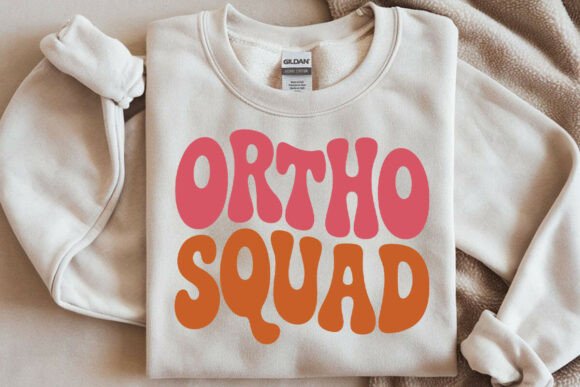
Ortho Squad SVG, Nurse Appreciation
A Retro Wavy Text Design That Feels Like a Hug — With Real Embroidery Caveats
I pulled up Ortho Squad SVG, Nurse Appreciation last week while prepping a small-batch order of embroidered canvas tote bags for a local orthopedic clinic’s staff appreciation day. My first impression? It’s warm, approachable, and instantly legible — but not in the way a crisp sans-serif would be. The retro wavy text gives it personality without leaning into kitsch. It reads like a friendly nod between colleagues, not a corporate slogan. That tone matters — especially when you’re stitching something meant to land emotionally on a nurse’s shoulder or apron pocket.
Where This Design Naturally Lives (and Where It Struggles)
Ortho Squad SVG, Nurse Appreciation thrives on stable, medium-weight fabrics: cotton twill tote bags, midweight sweatshirts, structured aprons, and pillow covers with tight weaves. I tested it on a 100% cotton tea towel — minimal shrinkage, clean stitch definition, and the wavy baseline held its shape beautifully under satin-stitched lettering. On baby onesies? Proceed with caution. The curves are gentle, yes — but tiny letterforms + stretchy knit fabric = potential distortion unless you use lightweight cutaway stabilizer and reduce density slightly.
It’s not built for dense fill-stitch backgrounds or intricate applique layers. There’s no florals, no icons, no secondary motifs — just focused, rhythmic typography. That simplicity is its strength *and* its limit. If you’re designing an embroidered patch for a hospital volunteer program, this works cleanly at 3.5" wide. If you’re trying to scale it down to 1.75" for a cap front? The inner curves start to blur, especially in lower-density satin stitches. Test it first — don’t assume your machine will auto-compensate.
Fabric & Fit: What You’ll Actually Notice Stitching It
- Dark fabric? Works best with high-contrast thread — think bright white or safety orange against navy or charcoal. Avoid pastel threads unless you’re stitching on cream or oatmeal fabric.
- Textured fabric? Linen blends or heavy terry cloth can swallow fine wave details. Stick to smoother surfaces unless you’re willing to add extra stabilizer layers and adjust top tension.
- Curved surfaces? Caps and curved pockets demand careful hooping and possibly re-digitizing minor curve adjustments — the original file isn’t optimized for that geometry out of the box.
- Frequent washing? The design has moderate stitch density — not overly heavy, not sparse. It’ll hold up well on kitchen towels or boutique sweatshirts, but avoid using it on items meant for daily industrial laundering unless you verify thread quality and stabilizer adhesion.
What It Adds — and What It Doesn’t Promise
This isn’t a “wow” design — it’s a “yes, this feels right” design. When stitched on a soft unisex sweatshirt for a nurse’s birthday gift, it landed as sincere, not saccharine. Customers recognize the ortho/nursing crossover immediately, and the retro styling avoids feeling dated because it leans into confidence, not nostalgia.
It boosts perceived value on handmade products where authenticity matters — think Etsy listings for personalized gifts or craft fair merchandise. A customer buying a linen pillow cover with Ortho Squad SVG, Nurse Appreciation stitched in tonal ecru thread doesn’t see clip art; they see intention. That builds trust. But it won’t carry a full brand identity alone — it’s a strong supporting element, not a logo replacement.
For small shop owners: this fits neatly into seasonal bundles — pair it with simple heart or stethoscope icons (if licensed) for holiday embroidery or new-hire welcome kits. As a standalone machine embroidery design, it’s versatile enough for custom apparel, but don’t expect it to scale across every product type without testing.
Practical Designer Notes Before You Stitch
- Always run a test on scrap fabric matching your final product’s weight and stretch — especially for baby embroidery or sweatshirt embroidery.
- Check thread color contrast early. Print a black-and-white mockup to assess readability before committing to thread spools.
- Review stitch density visually — look for areas where satin stitches might overlap too tightly near the wave peaks.
- Confirm hoop size compatibility. If you’re using a 4x4 hoop, verify the design fits comfortably with margin room for hooping stability.
- Inspect small corners and inner curves at 200% zoom in your embroidery software — subtle gaps or jumps can appear only at stitch-out.
- Use appropriate stabilizer: tear-away for stable cottons, cutaway for knits or lightweight linens.
- Double-check licensing terms before selling finished products or listing digital embroidery files. This is a digital embroidery file — commercial use rights aren’t implied unless explicitly stated.
Final Thought: A Quietly Effective Tool for Your Craft Business
Ortho Squad SVG, Nurse Appreciation won’t shout across a craft fair booth — but it’ll make someone pause, smile, and say, “That’s *exactly* what my sister-in-law needs.” It’s thoughtful, adaptable, and rooted in real-world recognition. As a T-Shirt Designs asset, it holds up well on crewnecks and tees — but its true home is in personalized gifts and small-shop merchandise where clarity, warmth, and professional execution matter more than flash.
If you’re an Etsy seller building a niche around healthcare-themed handmade products, or a boutique embroiderer curating designs for nurse appreciation month, this is a reliable, mood-aligned addition. Just remember: great embroidery project outcomes start with smart prep — not just pretty files. Test it. Tweak it. Then let it do what it does best: connect.